A Venn Academy Trust School
– Together we will…
Venn is a pioneering academy trust, committed to building educational environments where all pupils are inspired to become lifelong learners who achieve the very highest standards possible.
Collaborating with all partners, the Trust works with its unique settings to create world class learning experiences for all.
Registered address:
Venn Academy Trust
Albion House
Albion Lane
Willerby
East Yorkshire
HU10 6TS.
A charitable company limited by guarantee registered in England & Wales (company number: 09662303).
Our approach to Reading & Phonics
Our aim is that Griffin children will develop a love for reading. We believe reading is a vital skill that will support children’s learning across the whole curriculum. At Griffin, we will ensure that our children are taught to read with fluency, accuracy and understanding through a variety of discreet and cross-curricular learning opportunities. Above all, we want children in our school to become enthusiastic, independent and reflective readers who enjoy reading and read for pleasure. The development of reading cannot be seen in isolation from writing, speaking and listening; the best readers are the best writers.
We teach reading from Foundation Stage to Year 6. This can be in the form of one-to-one reading with an adult, shared reading, whole-class guiding reading*, cross-curricular opportunities and independent reading. Griffin’s reading curriculum has three strands:
- Phonics, decoding and word reading,
- Comprehension, including vocabulary,
- Encouraging Reading for Pleasure and deepening engagement of children in reading
In EYFS and Key Stage 1, we have fidelity to the systematic synthetic phonics programme Little Wandle Letters and Sounds Revised. This is also used for catch up and intervention in Key Stage 2. We use Collins Big Cat phonically decodable reading books matched to learning in Phonics.
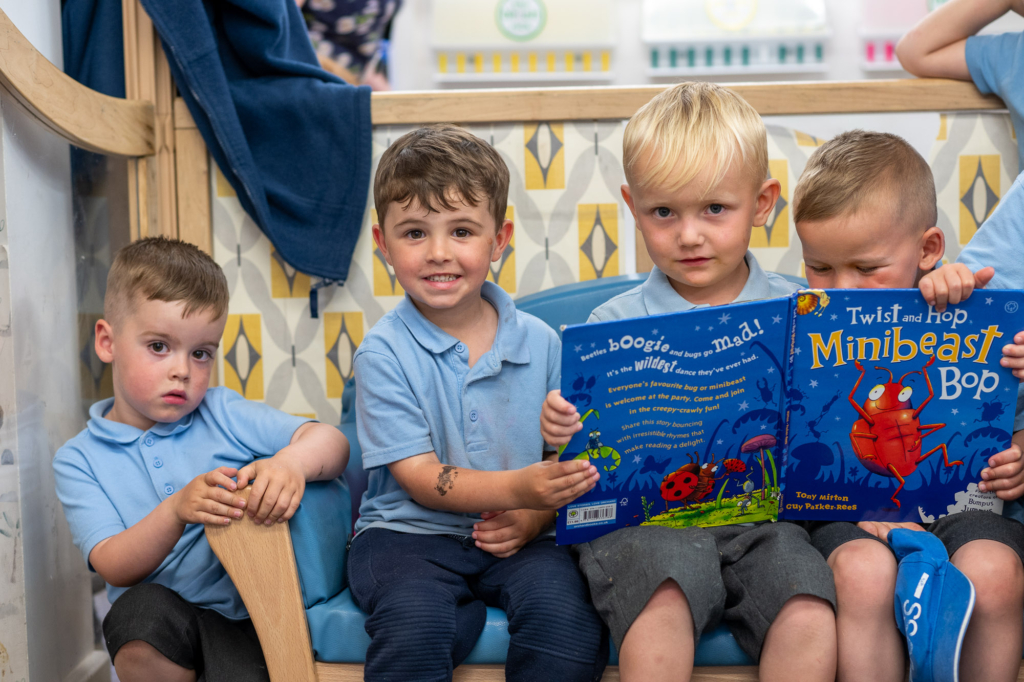
A love of reading is promoted through additional activities including author and poet visits; book fairs; an annual book day; paired reading; shared reading with younger children and parental reading workshops in the foundation stage. We also use a range of other reading strategies to broaden children’s understanding, interest and enjoyment of reading. In Key Stage 2, as their reading develops, children are encouraged to read from a wide range of fiction and non-fiction books.
Parents are encouraged to support reading at home and children read daily. Children in EYFS and KS1 take home a phonically decodable book matched to their learning in Phonics. Pupils also have access to a wide range of year group appropriate home reading books and e-books, which children choose themselves. Each child in school has an individual reading record where reading is recorded and tracked and is a means of communicating development to the child, parent and teacher. Children are also encouraged to choose books from the shared reading shelves for use during reading for pleasure time in school.
*What does whole class guiding reading look like?
- All children read the same text which has been carefully selected. Children are exposed to a wide variety over the year.
- Teachers model reading by ‘thinking aloud’ to show the process we go through as readers.
- Effective discussion is paramount and allows for purposeful speaking and listening activities.
- Three levels of questioning: Looking, Clue and Thinking.
- Vocabulary understanding is key to comprehension. With a focus on vocabulary, our children broaden their own vocabulary and explore and explain the meaning of words in context.
- The teaching and application of specific comprehension strategies.
The Little Wandle Letters and Sounds Revised website has lots of useful information for parents and carers to support with Phonics and early reading at home.
https://www.littlewandlelettersandsounds.org.uk/resources/for-parents/
I like school because we do lots of fun activities!
It is really easy to make new friends. That is an amazing thing about this School!
I love doing sports at Griffin. It keeps me fit and healthy!
My favourite lesson at school is English. I can let my imagination run wild!
The best thing about school is seeing my friends and the teachers.
I love doing our Thursday activities. They’re fun and teach me something new.